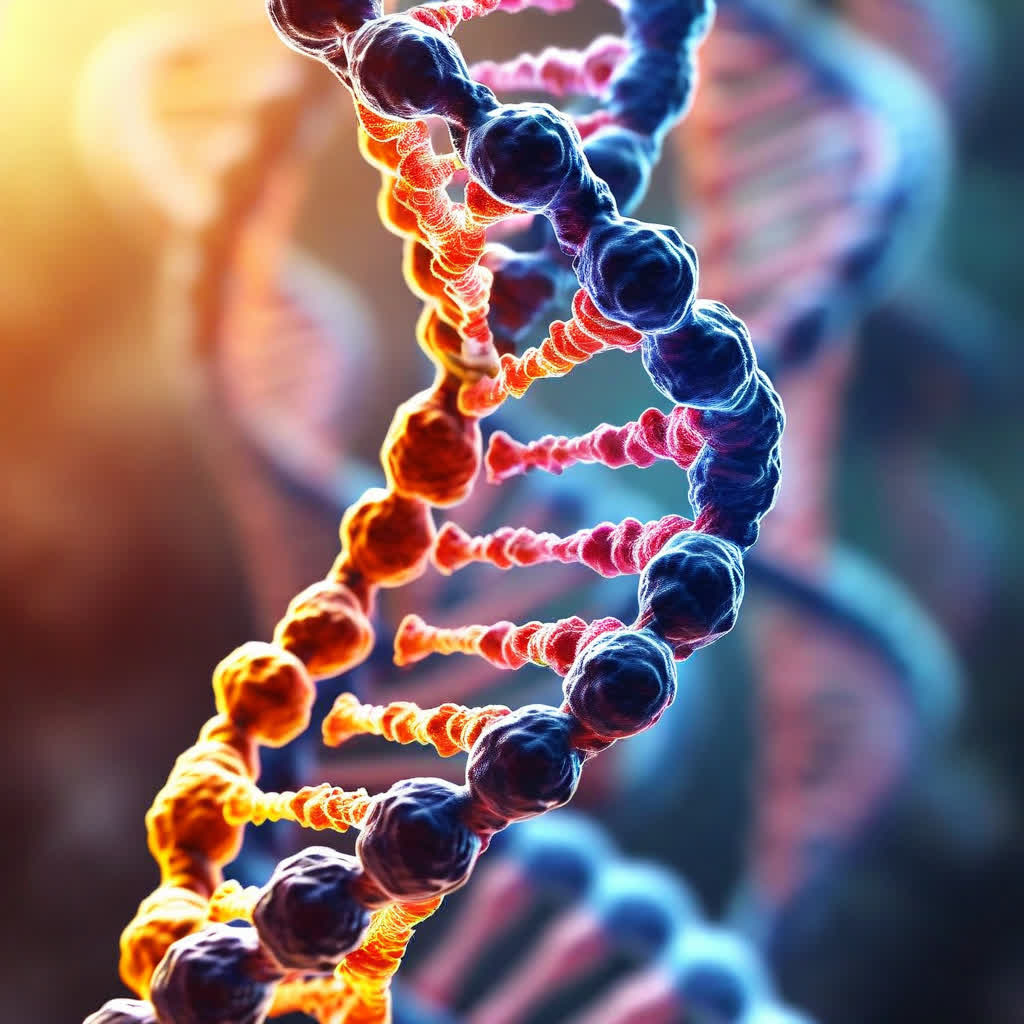
DNA as a Biological Antenna: Exploring the Evidence for Electromagnetic Interaction
Introduction: Your Body’s Most Famous Molecule
Deoxyribonucleic acid, or DNA, is universally celebrated as the blueprint of life. It contains the genetic instructions for the development, functioning, growth, and reproduction of all known organisms and many viruses. This role is fundamental to biology. But what if this remarkable molecule has another, less understood function? Could DNA also act as a sophisticated biological antenna, capable of interacting with the ever-present electromagnetic fields (EMF) in our environment?
This question marks the frontier of an intriguing and provocative area of biophysics. This article will objectively explore the scientific hypothesis that DNA behaves like a fractal antenna. We will examine the theoretical model, review key evidence from computer simulations, and summarize the biological studies that suggest this interaction is not just possible, but may have profound and tangible effects on cellular life.
——————————————————————————–
1. The Fractal Antenna Hypothesis: More Than Just a Blueprint
To understand how DNA might interact with electromagnetic fields, we first need to look at a special class of antenna technology. Unlike the simple antennas on an old radio, which are tuned to a narrow range of frequencies, fractal antennas are designed for exceptional versatility.
1.1. What Makes an Antenna “Fractal”?
A fractal antenna is an antenna that uses a self-similar design to receive and transmit electromagnetic waves. For a non-engineering audience, this means it has two key properties that allow it to operate over an incredibly wide range of frequencies:
- Self-Similarity: The physical design contains repeating patterns at different scales. A small piece of the antenna looks geometrically similar to a larger piece, which in turn looks similar to the whole structure.
- Wideband Reception: Because of its self-similar structure, the antenna can efficiently interact with (receive or transmit) EMF across a broad spectrum of frequencies, rather than being optimized for just one.
1.2. Why Propose This Model for DNA?
Scientists propose this model because the DNA molecule, when compacted inside the cell’s nucleus, appears to exhibit the two essential structural characteristics of a fractal antenna: the ability to conduct electricity and a profound self-symmetry.
The table below compares the required properties of a fractal antenna with the observed properties of DNA.
| Fractal Antenna Characteristic | Evidence in DNA Structure |
| Electronic Conduction | The delocalised π electrons found in the stacked base pairs of DNA have been shown to move along the double helix. This flow of electrons is a form of electronic conduction, a prerequisite for any material to function as an antenna. |
| Self-Symmetry (Compaction) | To fit within the nucleus, DNA is compacted into a series of nested, coiled structures. This creates repeating shapes at different scales, a hallmark of fractal geometry. The levels of compaction include: Double helix (1 nm diameter), Chromatin fiber (10 nm diameter), Solenoid (30 nm diameter), and Hollow tube (200 nm diameter). |
With this theoretical framework in place, the next logical step for researchers was to test whether a model of DNA would actually behave like an antenna in a simulation.
——————————————————————————–
2. Testing the Hypothesis: Insights from Computer Simulations
Computer modeling provides a powerful tool for scientists to test the physical plausibility of the DNA-as-antenna hypothesis. By creating a digital twin of the DNA molecule based on its known physical dimensions and properties, researchers can simulate how it responds to electromagnetic energy.
2.1. Key Simulation Findings
One key study modeled a segment of A-DNA (a specific structural form of the double helix) as a helical antenna. The results provided strong support for the hypothesis, yielding several important findings:
- Resonance Frequency The simulation showed that the modeled DNA structure strongly resonates with electromagnetic waves at 34 GHz. Significance: This demonstrates a specific frequency at which the interaction is particularly efficient, confirming that the molecule has predictable antenna-like properties.
- Positive Gain The model exhibited a positive gain of 1.7 dBi. Significance: In antenna theory, a positive gain means the structure can effectively concentrate and radiate energy rather than losing it. This is a fundamental characteristic of a functioning antenna.
- Vibrational Wavelengths The simulation’s results for the wavelength range of structural vibrations were consistent with other theoretical models of DNA vibration. Significance: This agreement with separate theoretical work lends credibility to the simulation’s accuracy and the underlying physical assumptions.
- Energy Transfer The analysis suggested that energy could be transmitted efficiently along the DNA structure through a soliton-based mechanism (a self-reinforcing wave that maintains its shape). Significance: This points to a potential pathway for how absorbed electromagnetic energy could be transported along the molecule to influence other regions.
While these simulations provide strong theoretical support, the critical question is whether evidence of this interaction can be observed in living biological systems.
——————————————————————————–
3. From Simulation to Cell: The Biological Evidence
If DNA interacts with EMF, we would expect to see tangible effects within living cells. Scientific studies have reported biological evidence at multiple levels, from cellular defense mechanisms to large-scale population studies.
3.1. The Cellular Alarm: Activating the Stress Response
When cells are exposed to potentially harmful stimuli, they activate a protective mechanism known as the “stress response,” which involves synthesizing special stress proteins. Studies have shown that exposing cells to EMF in both the Extremely Low Frequency (ELF) range (like from power lines) and the Radio Frequency (RF) range (like from cell phones) activates this same stress response. This indicates that the cell perceives the EMF as a potential threat and initiates a defensive action at the genetic level.
3.2. Evidence of Physical Damage: DNA Strand Breaks
The interaction between EMF and DNA appears to be strong enough to cause physical damage. Multiple studies have reported both single-strand and double-strand breaks in DNA following exposure to non-ionizing EMF. This is a significant finding, as strand breaks are a form of DNA damage that, if not properly repaired, can lead to mutations.
3.3. Population-Level Clues: Epidemiological Links
Epidemiological studies, which analyze patterns of disease in human populations, have provided further supporting evidence. For example, large-scale studies have found statistical correlations between chronic EMF exposure from different sources and increased health risks:
- Power Lines (ELF): Pooled analyses have linked exposure to power lines with an increased risk for childhood leukemia.
- Cell Phones (RF): Other studies have reported associations between long-term cell phone use and an increased risk for certain types of brain and salivary gland tumors.
It is crucial to note that these studies show a correlation, not definitive proof of causation. However, they contribute to a body of evidence suggesting that EMF exposure has measurable biological effects that warrant further investigation.
Observing these biological effects raises a fundamental question: how exactly could an electromagnetic field cause these changes within the DNA molecule?
——————————————————————————–
4. The Proposed Mechanism: How Might the Interaction Work?
Researchers have proposed a plausible physical mechanism to explain how the relatively low energy of non-ionizing EMF could influence the massive DNA molecule. The interaction appears to center on DNA’s mobile electrons.
4.1. An Interaction with Electrons
The core proposal is that incoming EMF interacts directly with the delocalised π electrons within the stacked bases of the DNA double helix.
- An electron has a very low mass and a negative charge, making it highly susceptible to acceleration by electric and magnetic fields.
- Even a low-strength field can induce movement in these electrons.
- This EMF-induced electron movement can lead to temporary local charging within the molecule, which could weaken the bonds holding the two DNA strands together and cause them to separate. This separation is a necessary first step for both DNA damage and gene activation.
4.2. A Specific “Responsive Element”
Further research has pinpointed a specific DNA sequence that appears to be a “hotspot” for this interaction. A nucleotide sequence, nCTCTn, located in the promoter region of the HSP70 stress gene, has been identified as essential for the cell’s response to EMF. Notably, the promoters of both the HSP70 stress gene and the EMF-activated oncogene, c-myc, contain multiple copies of this responsive sequence.
The bases in this sequence (Cytosine and Thymine) have low electron affinities, meaning their electrons can be displaced more easily than those in other bases. This makes these specific genetic sites particularly susceptible to influence by external fields, providing a testable and specific component of the broader interaction mechanism.
If DNA does indeed interact with environmental EMF through such a mechanism, it could have profound implications beyond cell biology, potentially impacting our understanding of evolution and public health.
——————————————————————————–
5. Broader Implications and Open Questions
The hypothesis that DNA acts as a fractal antenna is more than a scientific curiosity; it opens up new ways of thinking about biology, evolution, and safety in our increasingly electrified world.
5.1. A New Factor in Evolution?
The physical arrangement of DNA could have played a role in the speed of evolution.
- Prokaryotes (like bacteria) have simple, circular DNA that is not fractal.
- Eukaryotes (like plants and animals) evolved to have complex, compacted, fractal DNA in a nucleus.
This structural difference may be significant. The fractal DNA of eukaryotes would be responsive to a much wider range of natural EMF (from solar radiation to atmospheric electrical discharges) than the non-fractal DNA of prokaryotes. This increased interaction could have led to a higher rate of mutation and genetic change, potentially accelerating the pace of evolution that led to the complex life we see today.
5.2. Rethinking Safety Standards
Current safety standards for EMF exposure are largely based on thermal effects—that is, the power level at which radiation begins to heat biological tissue. This research highlights a critical gap: the evidence for DNA damage and the stress response occurs at non-thermal energy levels, far below the heating thresholds measured by standards like the specific absorption rate (SAR).
This suggests that current standards may be inadequate to address these non-thermal biological effects. Researchers in this field argue for the development of a new, biologically-based safety standard that considers the total cumulative exposure across the entire electromagnetic spectrum.
5.3. Conclusion: An Evolving Field
A compelling body of evidence from structural analysis, computer simulations, and a wide range of biological studies suggests that DNA possesses the key properties of a fractal antenna. This allows it to interact with a broad spectrum of electromagnetic fields in our environment. The answers it yields will not only have significant implications for our understanding of cell biology and human health but could fundamentally redefine our view of DNA—from a static library of code to a dynamic participant in the energetic environment of the cell and the world.
*generated using NotebookLM
Sources