Source: https://osf.io/9rch2/files/d8gps by Adam James Parkes
Methodology Overview: Testing Theoretical Physics against the SPARC Database
This document outlines the rigorous quantitative methodology used to validate the ChronoGravity framework. By leveraging the SPARC (Spitzer Photometry and Accurate Rotation Curves) database, this study moves beyond theoretical abstraction to test a specific, falsifiable prediction of gravitational acceleration on a galactic scale.
1. The Theoretical Foundation: A Bold Prediction
The ChronoGravity framework distinguishes itself by proposing a “consistency relation” that links local galactic dynamics to the global expansion of the universe. Unlike MOND (Modified Newtonian Dynamics) or other alternative gravity models that often treat the acceleration scale (a_0) as a free parameter to be tuned, ChronoGravity predicts a fixed value based on the cosmological constant (\Lambda) and the Hubble constant (H_0).
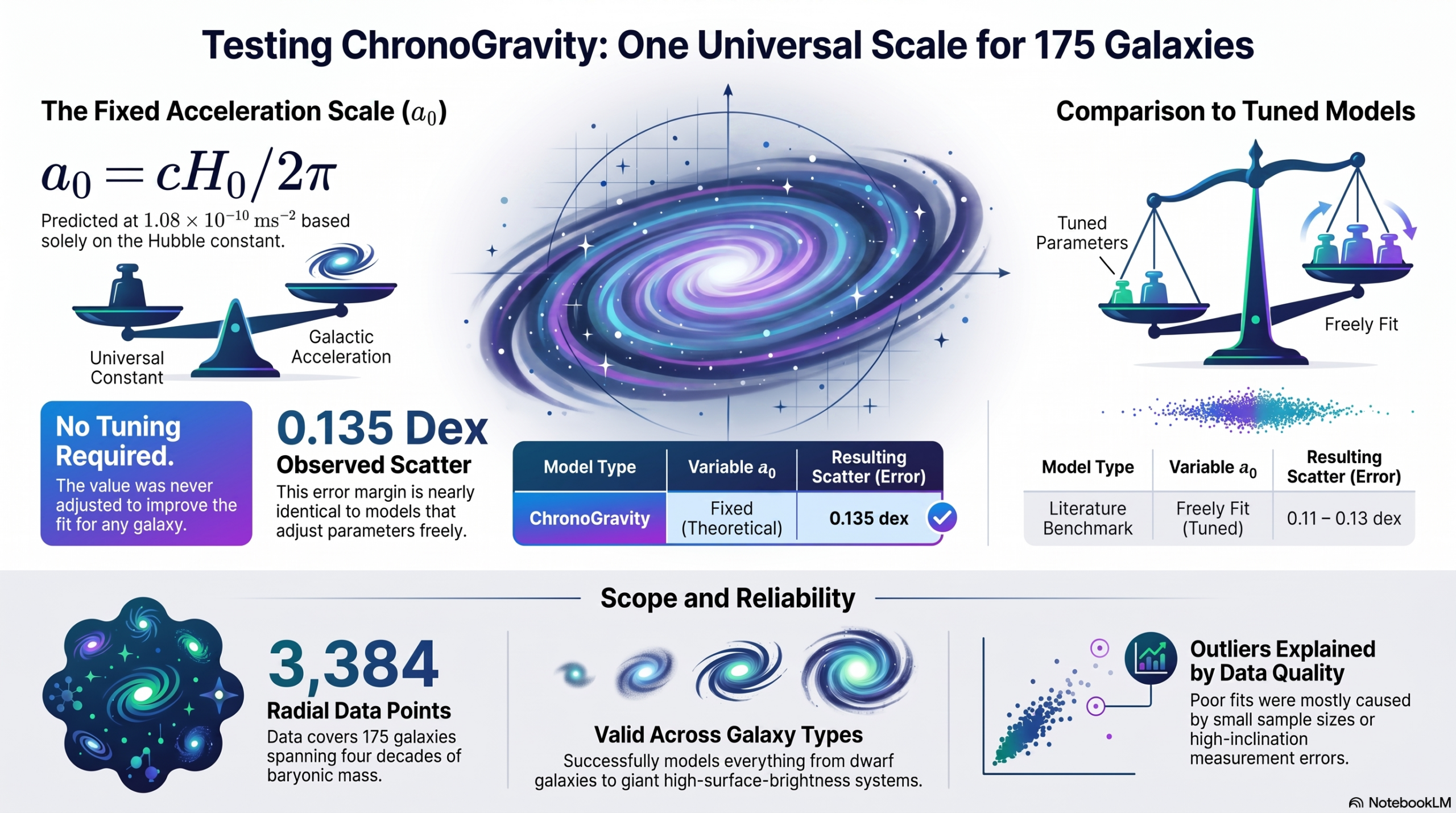
The Mathematical Prediction: The framework identifies a_0 with the cuscuton potential scale: a_0 = \frac{c^2 \sqrt{\Lambda/3}}{2\pi} By adopting the relationship \Lambda = 3H_0^2/c^2, this simplifies to the parameter-free prediction: a_0 = \frac{cH_0}{2\pi} \approx 1.08 \times 10^{-10} \text{ m/s}^2
This formula represents a synthesis of three critical pillars:
- c: The speed of light, representing the relativistic limit.
- H_0: The Hubble constant, representing the current rate of cosmic expansion.
- 2\pi: A numerical prefactor derived from the theory’s specific geometric and 5D-origin structure.
Insight: Falsifiability vs. Fitting In standard literature, a_0 is often fit to data, typically yielding a value around 1.2 \times 10^{-10} \text{ m/s}^2. By fixing the value at 1.08 \times 10^{-10} \text{ m/s}^2, researchers eliminate the “luxury of adjustment.” If the galactic observations do not align with this cosmologically derived number, the theory is effectively falsified. This high-stakes approach is essential for a theory to be considered scientifically robust.
To move from this abstract prediction to a validated model, the framework must be stress-tested against a massive, high-fidelity dataset.
2. The Source Material: Understanding the SPARC Database
The study utilizes the “Rotmod LTG.zip” data product from the SPARC database, a gold standard in extragalactic astronomy. This dataset provides the necessary resolution to separate visible matter contributions from observed kinematic behavior.
| Data Component | Scientific Description |
| 175 Galaxies | The full sample of late-type galaxies, ranging from gas-dominated dwarfs to massive, bulge-dominated giants. |
| 3384 Radial Data Points | Individual measurements of circular velocity taken at various radii (R) from galactic centers. |
| Observed Velocity (V_{obs}) | High-precision measurements of gas and stellar motion, including associated uncertainties (\sigma_i). |
| Newtonian Contributions | Calculated velocity components for the gas (V_{gas}), stellar disk (V_{disk}), and bulge (V_{bul}). |
Insight: The Advantage of Dynamic Range The primary strength of the SPARC database is its diversity, spanning four decades in baryonic mass. By including galaxies across a vast range of masses and surface brightnesses, the methodology ensures the theory is not merely successful in one niche environment, but functions as a universal law of gravity.
These raw observations serve as the input for a mathematical engine designed to predict total acceleration.
3. The Mathematical Engine: The AQUAL Sector and Newtonian Acceleration
The researchers apply the AQUAL (A QUAdratic Lagrangian) sector of the theory to derive the predicted total acceleration (g) from the Newtonian baryonic acceleration (g_N).
The Computational Sequence:
- Newtonian Acceleration (g_N): Calculated using the visible matter components where g_N(R) = (\Upsilon_{disk}V_{disk}^2 + \Upsilon_{bul}V_{bul}^2 + V_{gas}|V_{gas}|)/R.
- The Interpolation Function: The theory utilizes a Standard Form function to bridge Newtonian and modified regimes: \mu(y) = \frac{y}{\sqrt{1+y^2}}
- Numerical Solution: Because the AQUAL relation g \mu(g/a_0) = g_N is non-linear, researchers use Newton’s method to solve for g at every radial point in the database.
- Quadratic Screening: This mathematical constraint ensures the theory transitions correctly between the modified regime and the standard Newtonian limit.
Insight: The Limits of Approximation For computational tractability in this initial 175-galaxy test, the researchers utilized a point-mass/spherical approximation. While effective for the majority of the sample, this approximation is known to be least appropriate for high-surface-brightness systems, where the specific geometry of the galactic disk significantly influences the local gravitational field.
This engine allows researchers to isolate the only remaining unknown: the stellar mass.
4. Isolating Variables: The “Fixed vs. Free” Protocol
To ensure the test remains “parameter-free” regarding gravity itself, the experiment distinguishes between the theory’s prediction and the individual characteristics of each galaxy.
| The Fixed Parameter (a_0) | The Free Parameter (\Upsilon) |
| The acceleration scale is held strictly at 1.08 \times 10^{-10} \text{ m/s}^2. | The stellar mass-to-light ratio (\Upsilon) is the only variable allowed to adjust. |
| Never adjusted to improve the fit quality of any galaxy. | Bounded within the physically realistic range of [0.05, 2.0]. |
Insight: Least-Squares Minimization The researchers employ “Least-Squares Minimization” to find the optimal \Upsilon for each galaxy. This process minimizes the \chi^2 value—the difference between the predicted velocity and the observed V_{obs}. By allowing \Upsilon to vary within a strict physical bound, the study accounts for different stellar populations without compromising the fixed nature of the gravitational theory being tested.
5. Benchmarking Success: The Radial Acceleration Relation (RAR)
The success of the model is evaluated via the Radial Acceleration Relation (RAR), which compares observed acceleration against the Newtonian prediction for all 3384 data points, as visualized in [SOURCE_IMAGE_1].
Quantitative Results:
- Total Scatter (\sigma_{RAR}): 0.135 dex
- Median Deviation: 0.042 dex
- Fit Quality: The median \chi^2/N is 2.27, indicating a unimodal distribution with no catastrophic failures ([SOURCE_IMAGE_2]).
Insight: The “Cost” of a Fixed Prediction In the seminal work by Li et al. (2018), the scatter was measured at 0.11–0.13 dex when a_0 was allowed to vary as a free parameter. Fixing a_0 to the ChronoGravity prediction results in a scatter of 0.135 dex. Note that “dex” is a logarithmic unit; a scatter of 0.135 dex represents a factor of approximately 1.36. The fact that fixing a_0 “costs” only a few hundredths of a dex compared to a freely-fit model provides powerful empirical support for the ChronoGravity framework.
6. Analyzing Exceptions: The 15 Outliers
Despite the overall success, 15 galaxies were identified as outliers. As summarized in Table 1 of the source, these “worst-fit” systems fall into two distinct categories:
- Small-N Systems: Galaxies like PGC51017 (which has an extreme \chi^2/N of 49.1) and UGC07125 (42.9) have very few data points. In these cases, even a single noisy measurement or slight asymmetry can disproportionately skew the statistical fit.
- High-Inclination Systems: Galaxies such as NGC0891 and NGC5371 (44.6) are “edge-on” to our line of sight. These systems are notoriously difficult to correct for inclination, leading to higher systematic uncertainties.
Insight: Literature-Wide Challenges These outliers do not represent a unique failure of ChronoGravity. These specific galaxies are recognized as “troublemakers” across all gravitational studies in the literature. Their poor fits are generally attributed to data collection limitations and systematic uncertainties rather than a breakdown of the underlying physical model.
7. Conclusions and Next Steps in the Scientific Process
The first quantitative test of ChronoGravity proves that a value of a_0 derived purely from the Hubble rate can accurately predict galactic dynamics. A scatter of 0.135 dex across the entire SPARC sample is a non-trivial achievement that validates the framework’s central galactic-scale claim.
The methodology will now transition into a phase of refinement:
- [ ] Full Disk-Geometry: Implementation of a full disk-geometry AQUAL solver to replace the spherical approximation, specifically to address high-surface-brightness outliers like NGC2903 and IC4202.
- [ ] Direct Literature Comparison: A galaxy-by-galaxy performance audit against the Li et al. (2018) free-parameter study.
- [ ] Inclination Re-evaluation: A targeted analysis of high-inclination outliers against their specific published measurement uncertainties.
- [ ] Sample Expansion: Application of the fixed-parameter test to early-type (elliptical) galaxies and the direct baryonic Tully-Fisher relation.
By adhering to this transparent methodology, the framework continues to move toward a unified understanding of cosmic expansion and local gravity.
Tags: chronogravity, galaxy, spin