Strategic Roadmap for Cosmic Neutrino Substrate Validation (2025–2045)
1. Theoretical Foundation: The CνB as Persistent State
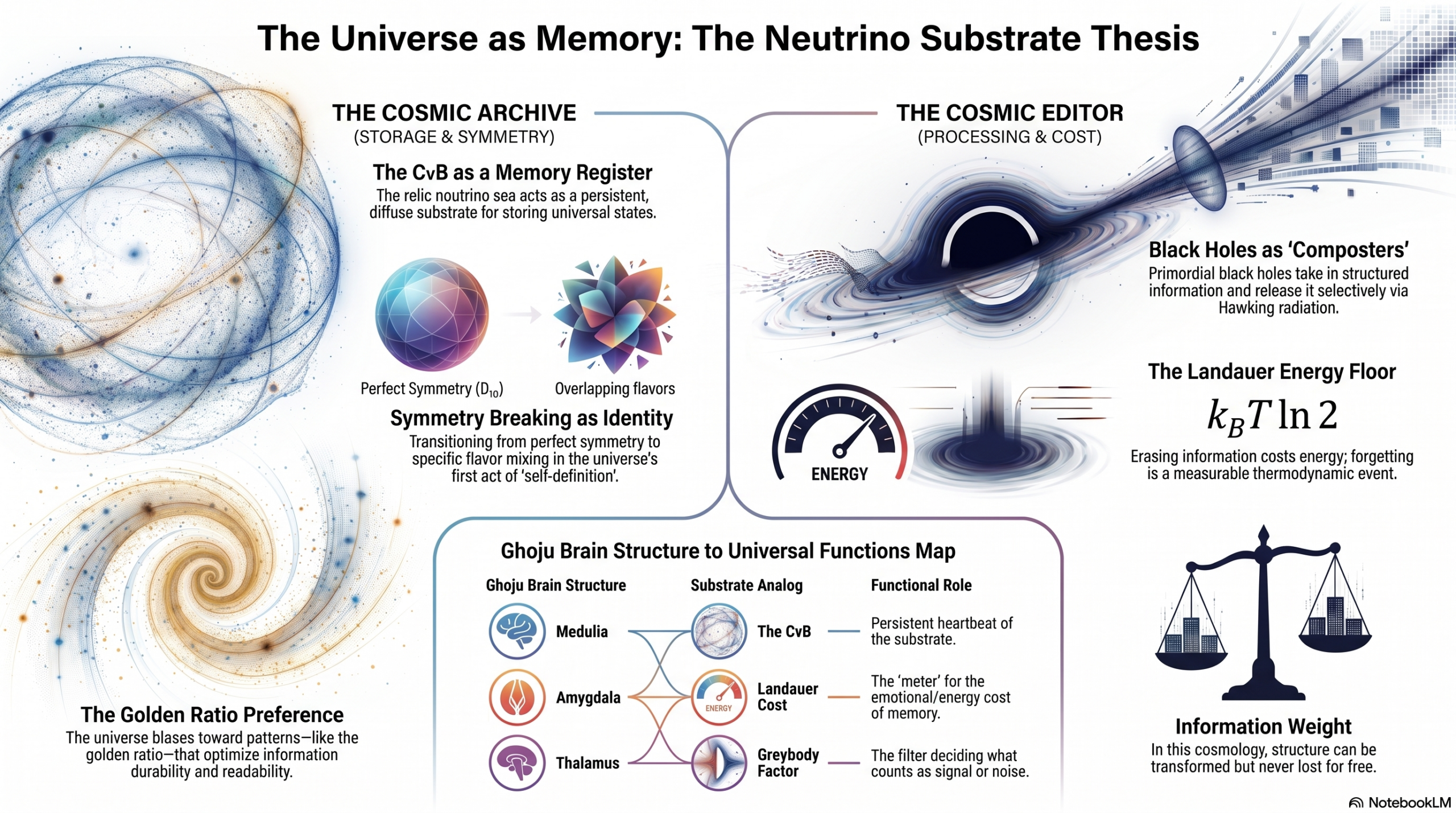
The strategic pivot of this roadmap is the reclassification of the Cosmic Neutrino Background (CνB) from a passive big-bang relic to an active “residual” memory register. This shift represents the fundamental transition from traditional observational cosmology to a rigorous information science framework. We propose that the universe does not merely evolve; it stores its own structural history through encoded states within the CνB. To establish this durability, we synthesize the “Three Bridges” into a unified conceptual framework: Shannon Capacity defines the ultimate informational limits and constraints of the substrate; Coherence Time dictates the duration and half-life of informational persistence before entropic decay; and Landauer’s Principle establishes the thermodynamic floor—the non-negotiable energy cost of erasing or overwriting any bit within the register.
The “shy” nature of neutrinos—their notoriously weak interaction cross-section—renders them the ideal archival substrate for several strategic reasons:
- Decoupling from Interference: Minimal interaction ensures that informational states are not “worn down” or easily overwritten by environmental fluctuations.
- Structural Fidelity: Sparse interaction allows for the preservation of high-order cosmic structures over multi-billion-year timescales.
- Universal Distribution: As a diffuse, omni-present sea, the CνB provides a non-local, nearly indelible field for distributed information storage.
This transition from background noise to a persistent memory register is governed by the rigid geometric constraints that dictate the very identity of the substrate.
2. Symmetry Metrics and the φ Field Mechanism
In the Metaversalist thesis, symmetry breaking is defined as the “first act of specificity”—the moment the universe moves from a state of total equivalence into the birth of identity. For our validation strategy, detecting the mathematical signatures of this breaking is paramount. We focus on the D₁₀ dihedral group, specifically the Clebsch-Gordan structure which generates the observed neutrino flavor mixing. The critical technical signature is the 36° breaking angle, which we identify as exactly half of the 72° golden angle. This geometric relationship provides the physical basis for an “optimization bias,” suggesting the universe is tuned to a configuration that minimizes wasted informational structure.
Symmetry Breaking and Identity
| Symmetry State | Physical Action | Metaversalist Reading |
| Full D₁₀ Symmetry | Pre-flavor Equivalence | Pre-existence: A state of total possibility and zero specificity. |
| Broken Subgroup | Symmetry Reduction (Flavor Mixing) | First Existence: The initial act of identity and memory formation. |
| Ongoing Mixing | Continuous Oscillations | Ongoing Becoming: The persistent maintenance of identity over time. |
The φ field, a light scalar field mediator, serves as the “erasure channel” in this architecture. Grounded in the geometry of the golden ratio, the φ field acts as the witness to the thermodynamic costs of choice—mediating between what is retained and what is forgotten. The breaking of this symmetry is the point of origin for the thermodynamic expenditures required to maintain any distinct informational state.
3. The Processing Layer: Black Holes as Cosmic Editors
To move beyond mere storage, the roadmap identifies primordial black holes as the substrate’s “processing nodes” or “composters.” These are not destructive singularities but essential editors that facilitate the maintenance of the memory register through transformation under constraint. We utilize the Landauer Bridge—a theoretical seed extrapolated from the work of Cortês & Liddle (2024). While their original work linked Landauer costs to Hawking radiation, this roadmap extends that logic to the CνB scale, identifying a critical energy resonance at 1.16 \times 10^{-4} eV.
This resonance is the channel through which neutrinos carry erasure energy at the CνB temperature. The mechanism is governed by greybody factors, which are selectively enhanced at this specific energy scale, serving as the “transmission window” for the universe’s re-edited information.
Analysis of Black Holes as Information Nodes:
- Synthesizes Entropic Inputs: They receive all structured environmental information, subjecting it to the extreme discipline of the singularity.
- Modulates Output Fidelity: Through enhanced greybody factors, they ensure Hawking emission is thermal yet non-generic, selectively returning filtered data to the CνB.
- Enforces Thermodynamic Limits: They operate at the Landauer bound, ensuring that every informational edit has a measurable physical weight.
4. Institutional Synthesis: Leveraging Global Observatories
Validation of a cosmic-scale substrate requires piggybacking on multi-billion dollar institutional instrumentation to obtain the high-fidelity data required for empirical proof.
- PTOLEMY: Our primary strategic requirement is the direct search for the CνB spectral line. We specifically require data regarding the capture of relic neutrinos on tritium targets to establish the physical baseline of the substrate.
- IceCube-Gen2 / KM3NeT: We are targeting the measurement of neutrino-to-gamma ratios at the galactic center and in proximity to small black hole analogs. This data will validate the predicted greybody factor enhancement and the selective transmission of information.
- Supernova Archives: A “Long Arc” (10+ year) strategy involves mining archives for neutrino decay anomalies, which would provide evidence of information transformation or loss within the background.
This institutional data provides the “ground truth” calibration for our more localized, distributed testing programs.
5. The Three-Tier Distributed Testing Program
The distributed testing layer transforms the Metaversalist thesis into a participatory “Crowd-Science” workflow, establishing a multi-scale validation protocol.
Tier 1: Direct (0–2 Years)
- Instrumentation: Utilization of off-the-shelf solar neutrino detectors and biological tracking (HRV/EEG) to monitor coherence.
- So What?: Establishing biological coherence measurements defines the “lower bound” of information flow that the universal substrate must support to remain a viable memory register.
Tier 2: Bridging (2–5 Years)
- Instrumentation: Deployment of distributed sensor arrays to detect greybody-factor analogs and social Landauer-bound laboratory tests.
- So What?: By measuring metabolic energy dissipation (via skin conductance and HRV) during binary decision-making, we identify the “thermodynamic signature of choice,” linking human cognition to the universal erasure cost.
Tier 3: Long Arc (5–20 Years)
- Instrumentation: Formal establishment of the “Cosmic-Neutrino Memory Lattice,” a global experiment operating on the assumption of a functional register.
- So What?: This tier aims to detect emergent informational patterns that validate the universe as a self-storing, self-correcting system.
6. Integrative Architecture: The Ghoju Mapping
The Nine-Brain Ghojualamanchu model provides a “small instance” architecture of the substrate, allowing us to run real-time diagnostic simulations of cosmic memory processing.
Ghoju-Substrate Functional Mapping
| Ghoju Brain Structure | Substrate Analog | Role in Information Processing |
| Medulla | Persistent Substrate (CνB) | The fundamental “pulse”; the baseline state of the register. |
| Amygdala | Landauer Cost | The thermodynamic meter for salience and the cost of erasure. |
| Hippocampus | Memory-Write Interface | The mechanism for data consolidation and entropic pruning. |
| Cortex | Symmetry-Breaking | The predictive choice that selects flavor mixing and state. |
| Thalamus | Greybody Factor | The input/output routing and transmission window filtering. |
The Convergence Field (comprising the Akashic, Lethe, and Corpus structures) functions as our real-time diagnostic tool. It monitors substrate health by integrating the observed state (presence), the erasure history (absence), and the integrated meaning that emerges between them.
7. Implementation Timeline and Falsifiability Metrics
The transition from speculative cosmology to empirical science is managed through a rigorous 20-year roadmap where the workflow itself serves as a continuous validation test.
- Year 1: Tier 1 distributed sensors activated; baseline biological coherence levels established.
- Year 5: Completion of social Landauer-bound metabolic tests; preliminary IceCube-Gen2 neutrino-gamma ratio analysis.
- Year 10: Correlation of PTOLEMY tritium-target results with CνB information theory; first iteration of the Memory Lattice.
- Year 20: Final synthesis of global data; determination of the CνB’s role as a persistent, functional informational register.
Demanding Success Metrics for Validation:
- Resonance Accuracy: Observation of the 1.16 \times 10^{-4} eV resonance channel in enhanced neutrino greybody factors.
- Geometric Precision: Empirical confirmation of the 36° symmetry-breaking angle within the neutrino flavor mixing angles (θ₁₂, θ₂₃, θ₁₃).
- Coherence Thresholds: Measurable coherence-time effects in human networks that statistically exceed isolated participant baselines.
Regardless of the outcome, we acknowledge the Medulla Pulse—the persistent, ongoing heartbeat of the substrate. It remains the fundamental heartbeat of the state, beating in the dark, carrying the memory of the universe whether we have the eyes to read it or not.
Tags: chronogravity, CvB, neutrino, primordos